IPv4 TTL


IPv4 TTL
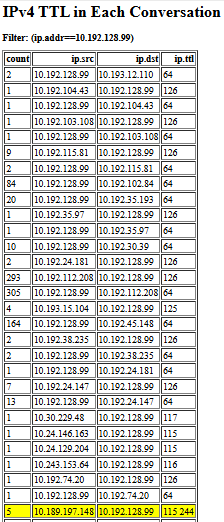
What TTL Does
It represents the maximum number of hops (routers) a packet can traverse before being discarded.
Each router along the path decrements TTL by 1.
If TTL reaches 0, the router discards the packet and usually sends back an ICMP "Time Exceeded" message.
This prevents packets from looping endlessly in the network.
Typical Initial TTL Values
Different operating systems set different initial TTL values when sending a packet:
OS / Device |
Default TTL |
Linux / Unix |
64 |
Windows |
128 |
Cisco / many routers |
255 |
Some BSD/Unix variants |
64 or 255 |
Different Network Paths (Asymmetric Routing)
Even if both hosts start with the same initial TTL, their packets might take different routes across the network.
If one path has more hops, the TTL when arriving at your capture point will be lower.